
Isle of Wight Release Date Types
A scheduled or anticipated date is a calculation based on the record as it stands. The actual Isle of Wight County inmate release date is the date the responsible custodian records the person leaving that custody episode. They can differ. A new court order, another sentence, a detainer, lost credits, or a corrected calculation may alter the plan. Release processing can also occur after the legal event that authorizes departure.
Pretrial detainees usually have no sentence-based date to calculate. A magistrate or judge can set bond, but a bond order does not show when all conditions were met or whether another hold blocked departure. For a sentenced person at Western Tidewater Regional Jail, the court judgment, jail credit, and jail record matter. For a state prisoner, VADOC performs the time computation. For a federal detainee housed by WTRJ, the federal authority controls.
The event label must stay attached to the date. A judgment date, parole decision date, credit calculation, and recorded jail exit are not interchangeable. If a record does not identify its label, ask the office that made it rather than naming it from context.
Find an Isle of Wight Release Date
The correct search path turns on custody type. Isle of Wight County sends adult local detainees to Western Tidewater Regional Jail in Suffolk. A person who leaves WTRJ may have returned to the community, transferred to VADOC, moved under another local hold, or remained in federal custody. The current JailTracker lookup is only a present-custody starting point, not a history of projected or past dates.
- Identify whether the person is pretrial, locally sentenced, state sentenced, or held for a federal authority.
- For WTRJ, call Booking at 757-539-3119 extension 543 and ask about the correct existing record.
- Search the Isle of Wight court case for the bond, disposition, sentence, and jail-credit context.
- For state custody, search VADOC by seven-digit DOC ID or by name and match the record carefully.
- Read only the exact date label shown. Do not convert a general status into a projected date.
- Confirm a planned date with the responsible records or time-computation office before relying on it.
A state transfer is not release. If the VADOC locator places the person at an institution, the WTRJ custody stage ended but state incarceration continues. A district-office result may instead be consistent with physical release into supervision. The Isle of Wight County released-inmate record guide explains how to request WTRJ's recorded release transaction when the actual local exit matters.
Note: A missing WTRJ roster entry supports more checking; it does not distinguish community release from transfer to another authority.
VADOC Isle of Wight Date Search
The VADOC Inmate and Supervisee Locator covers people currently in state custody or supervision. It accepts the first three letters of a first name with the last name, or a seven-digit DOC ID. Advanced filters include location, race, gender, and age range. VADOC says the data is updated daily, with a warning that information may be inaccurate or outdated.
The research did not confirm the exact label used for a date on a live public result. VADOC's explanatory source uses the general term “release date,” while notification material may use “anticipated release date.” Neither establishes that the locator displays a field called “Projected Release Date.” Therefore, a result must be read verbatim. If no date field appears, contact VADOC rather than inventing one from the sentence length.
The official locator image below shows the search entry point, not proof of a particular person's date.
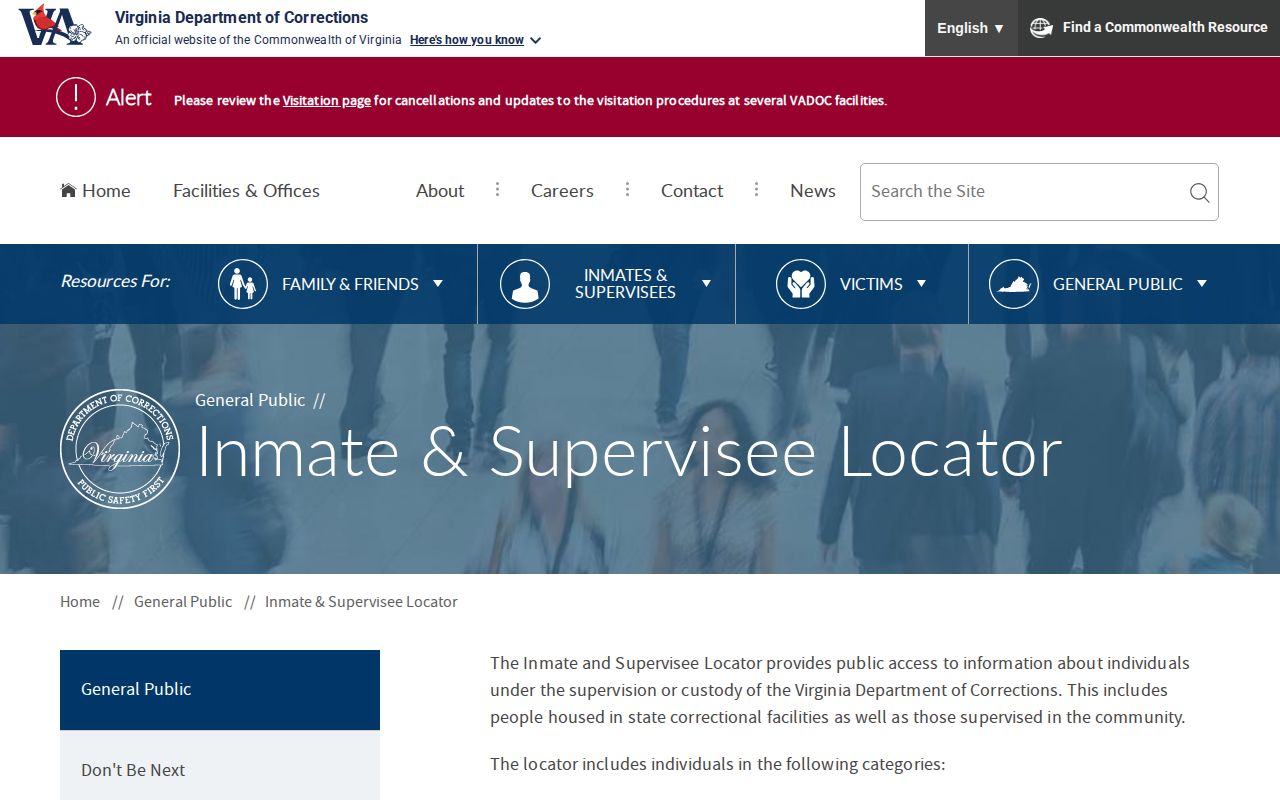
Its fields help narrow the right record, but the displayed result and VADOC computation remain the sources for any state date.
When a fully inactive person no longer falls within public locator scope, VADOC's FOIA page links Form 17 for inactive-offender records. The sentencing court supplies the judgment. VADOC central can be reached at 804-674-3000 or docmail@vadoc.virginia.gov for the appropriate Correspondence Unit or Court and Legal route.
Local court level also matters. Isle of Wight General District Court handles misdemeanors, bond matters, and felony preliminary hearings. Circuit Court handles felony adjudication and sentencing, appeals, and later revocation proceedings. A felony trail may begin in General District and continue in Circuit, so a search confined to one court can miss the order that controls jail credit or the sentence. Court dates explain legal action, but WTRJ still supplies the actual local release transaction.
Virginia Credits Shape Release Dates
Virginia uses different time-computation frameworks. VADOC describes good-conduct-allowance, or GCA, sentences as generally involving parole-eligible felonies committed before January 1, 1995 and misdemeanors before July 1, 2008. When active GCA sentences total more than twelve months, VADOC calculates discretionary parole eligibility, mandatory parole release, and good-time release dates. Under §§53.1-198 and 53.1-202, classifications can yield from zero to thirty good-conduct days for each thirty days served.
Earned-sentence-credit, or ESC, sentences generally cover felony offenses on or after January 1, 1995. Section 53.1-202.2 states that one earned sentence credit equals one day deducted. Section 53.1-202.3 then divides rates by offense eligibility and earning level. Listed ESC-1 offenses generally earn no more than 4.5 days per thirty served. Eligible ESC-2 offenses can earn up to fifteen days per thirty at Level I, with lower rates at other levels. The offense lists and exclusions control.
The current earned-sentence-credit rate statute shows why no single percentage can answer every Isle of Wight County inmate release date question.
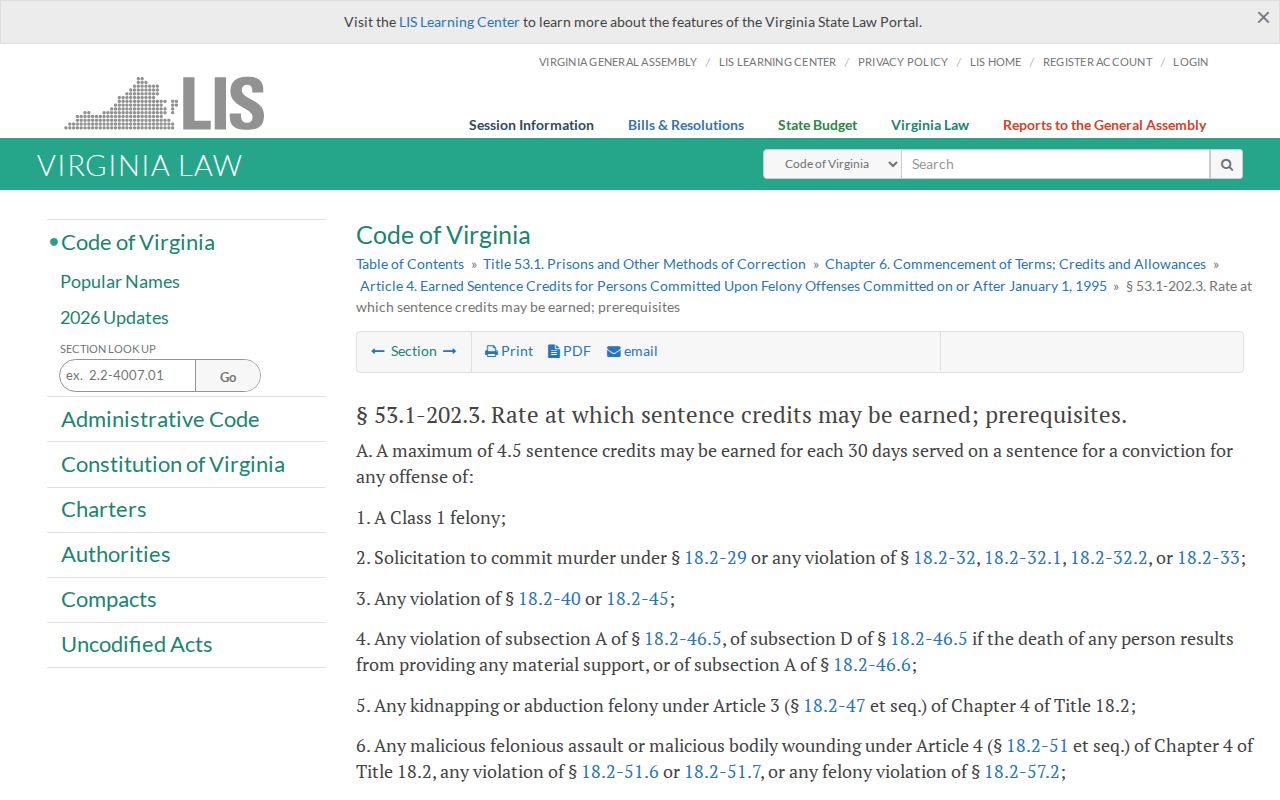
The statute image ties the rate to legal eligibility and level, rather than to a blanket formula.
Why Virginia's 85% Rule Varies
VADOC's probation and parole overview describes post-1995 truth in sentencing as serving at least 85 percent with good-time credit. That is a useful summary of the original ESC-1 structure, but it is not a universal current formula. Enhanced ESC-2 rates, excluded offenses, sentence combinations, and statutory exceptions can change the computation. The familiar percentage cannot be multiplied against every sentence.
Isle of Wight County cases also may combine time spent at WTRJ with a later VADOC term. Jail credit earned before state receipt is part of the calculation. Concurrent sentences run at the same time, while consecutive sentences run one after another. Offense date determines which framework may apply, and the current statute determines the earning category. Discipline can lead to forfeiture under §53.1-202.4.
County-jail time is no safer to estimate by subtraction. WTRJ can hold a pretrial detainee, a person serving a local misdemeanor term, a state-responsible inmate awaiting transfer, or someone held for another authority. No local WTRJ good-time or weekend-release policy was confirmed. Obtain the sentence order, confirm jail credit, and ask which computation framework applies.
The VADOC time-computation guide states that trained staff calculate the date after reviewing sentence documents and the applicable framework. That process is more than calendar arithmetic. Staff must reconcile the court term, qualifying pre-sentence custody, sentence order, applicable credit system, and later events. A family estimate can miss an overlap between cases or a consecutive term even when the basic sentence length is known.
Changes to Isle of Wight Dates
A date can move even after a careful calculation. VADOC identifies the imposed term, prior jail credit, sentence type, earning classification, disciplinary events, and other case events as variables. The local court may amend a judgment or impose an additional term. Another authority may lodge a detainer, which is a request or hold affecting what happens when the current custody stage ends.
Changes do not all mean the same thing. A correction can fix an input or legal calculation. A new judgment changes the source data. Credit forfeiture follows the applicable administrative process. A detainer may leave the sentence date intact while changing whether the person goes home or transfers when that date arrives. Asking which event changed prevents one revised date from being mistaken for a new conviction or a denied release.
| Factor | Possible effect | Best source |
|---|---|---|
| Jail credit | Changes time credited before state intake | Sentencing order and VADOC computation |
| Concurrent or consecutive terms | Changes how multiple sentences combine | Court judgment |
| Earning level or eligibility | Changes the rate of sentence credits | VADOC and current statute |
| Credit forfeiture | Can add time back after discipline | VADOC record and §53.1-202.4 |
| New order or sentence | Can revise the controlling term | Isle of Wight court |
| Detainer or outside hold | May prevent community return | Custodian and holding authority |
| Parole action | May create a later release path for an eligible case | Parole Board and VADOC |
A parole grant is not an immediate exit date. Under current Virginia procedure, actual release normally follows later, subject to statutory timing and exceptions. A denial also does not change a sentence into a new fixed date without the controlling VADOC computation.
Confirm Isle of Wight Release
Confirmation should pair a direct custody source with context. For a WTRJ event, request the existing booking and release entry, recorded date and time, and any existing release or transfer type that can lawfully be disclosed. Compare it with the Isle of Wight court action. For a state sentence, compare the current VADOC result with the judgment and time-computation information. For federal custody, use the responsible federal record rather than the state locator.
A request should identify the named booking or state record with enough detail to avoid a same-name error. Ask for an existing record, not a new calculation or certificate. If the office does not hold it, ask whether a known custodian can be identified.
VINELink may add a release or custody-change alert for a selected person when the facility and record appear in the live Virginia system. Coverage for every WTRJ inmate is not guaranteed. A notification says the reporting custody episode changed; it does not explain every hold or prove that supervision ended. The steps for registering and confirming the person are covered in the VINELink Release Check.
Keep the final conclusion narrow. “The jail recorded release on this date,” “VADOC displays this exact date label,” and “the court entered judgment on this date” are distinct, supportable statements. Combining them into one guessed Isle of Wight County inmate release date can hide a transfer, another hold, or an active supervision term.
Write down when each source was checked. A later VADOC update, court order, or jail transaction may replace an earlier estimate, so the newest record should be compared with the prior label rather than silently substituted.
This dated source trail is especially useful when jail credit, a detainer, or a corrected sentence changes the expected path without changing the person's identity.